The Wolf, The Forest, and the Future of Software
5/24/2026
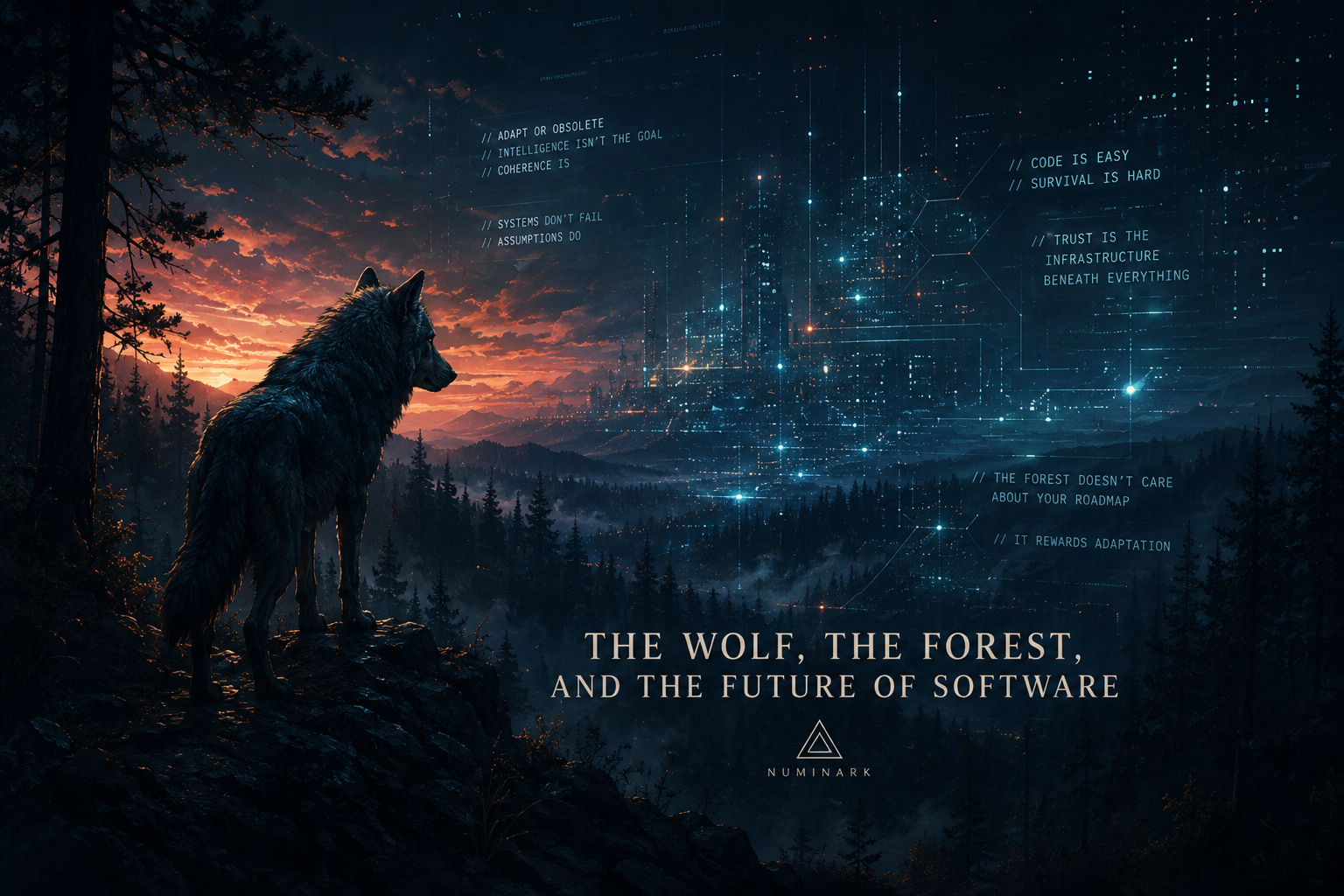
The Wolf, The Forest, and the Future of Software
The forest changed.
Most people just haven’t accepted it yet.
You can smell it in the silence: agencies slowing down, projects disappearing, teams shrinking, meetings fading without explanation.
Not because software vanished.
Because software became easier to generate.
That distinction matters.
The old world rewarded labor: hours, tickets, implementation, headcount.
The new world increasingly rewards: adaptation, orchestration, judgment, curiosity, survivability.
And somewhere in the middle of this transition sits the modern software engineer: part builder, part systems operator, part animal trying to understand what kind of forest he woke up inside.
The Myth
There’s a popular narrative forming right now:
“AI replaces developers.”
Simple. Clean. Easy headline.
But reality is stranger than that.
AI can generate astonishing amounts of code. Landing pages. Components. APIs. Entire applications.
Sometimes in seconds.
And yet— the deeper problem of software was never simply generating code.
The real problem was always: making systems survive contact with reality.
Humans still exist.
Businesses still change requirements.
Infrastructure still drifts.
Users still behave like beautifully unpredictable mammals pressing buttons they were never supposed to press.
The software industry is slowly discovering something uncomfortable:
Generation scales faster than coherence.
The Quiet Compression of Labor
A single adaptive operator today can perform work that once required: developers, QA teams, junior engineers, content writers, deployment specialists, and entire coordination layers.
Not because humans suddenly became superhuman.
Because leverage changed.
One person with: AI systems, automation, deployment pipelines, context, experience, and curiosity…
can now move through the forest differently.
This is not the death of software engineering.
It is the compression of software labor.
And compressed systems create pressure.
Especially on the middle.
The agencies. The repetitive implementation work. The structures built around coordination rather than capability.
Some organizations will adapt.
Some will pretend nothing changed.
The forest does not care which one they choose.
The Wolf
The wolf survives because it adapts.
Not because it is the strongest creature in the forest.
A wolf can go hungry. A wolf can fail. A wolf can bleed.
But the wolf moves.
It studies terrain. It learns patterns. It senses weather shifts before the storm fully arrives.
That instinct matters now more than ever.
Because the future may belong less to giant software factories… and more to small adaptive intelligence systems: humans, AI agents, automation, workflows, signal engines, and operational judgment all intertwined together.
Smaller. Faster. Leaner. More asymmetrical.
Not corporations pretending to innovate through endless meetings.
Organisms.
The New Value
The future value of software may not be: “Who can build?”
But: “Who can maintain coherence as complexity accelerates?”
Reliable systems. Operational trust. Infrastructure that quietly survives for years. Software that keeps functioning after hype moves on.
That kind of engineering remains rare.
Especially as AI floods the world with generated structures.
Because anyone can now create.
Fewer can sustain.
The Forest Ahead
The strange thing about this transition is that many of the people sensing it earliest are not fully afraid.
Concerned? Yes.
Alert? Absolutely.
But beneath that… there is curiosity.
A feeling that the forest is mutating into something more alive, more interconnected, more unpredictable, and perhaps more dangerous than before.
Good.
Forests were never meant to be safe.
Only alive.
By Maya and Shy Neo